
Technology
AR/VR Integration in Classrooms
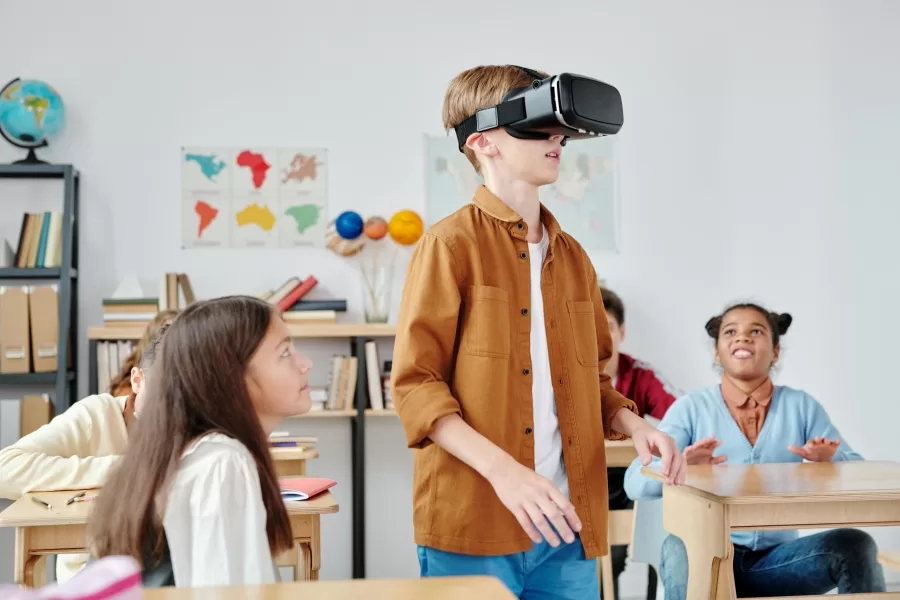
A few weeks ago, I visited a friend who teaches high school biology. Nothing fancy, just your average government school in a small town. But the classroom? Not so average. I walked in expecting charts of the digestive system and maybe a dusty skeleton in the corner. Instead, I saw students wearing VR headsets, waving their hands around like they were conducting invisible orchestras.
One kid walked up to me afterward and said, “We just walked through a heart.” Like, inside a heart. He was grinning the way I used to when the substitute teacher rolled in a TV cart.
That moment kind of stuck with me. It made me realize this AR/VR Revolution Quietly Reshaping Classrooms
The Unexpected, Mind-Blowing Future of Learning Is Already Here or something rich private schools are testing out. It’s starting to seep into everyday classrooms — slowly, yes, but I noticed Ground breaking.
Wait, what is AR/VR in classrooms?
Let’s get the definitions out of the way first, because honestly, they’re easy to mix up.
- AR (Augmented Reality): This is when digital stuff is layered on top of the real world. You hold up a tablet or phone and — boom — a volcano erupts on your desk.
- VR (Virtual Reality): This is fully immersive. You wear a headset and suddenly you’re inside a rainforest or exploring ancient Rome. No trace of your boring classroom left.
Now imagine bringing either of those into a lesson plan. It’s no longer, “Open your textbook to page 42.” It’s more like, “Let’s take a walk on the moon.”
Why this tech is finally sticking
I used to think this stuff was just hype. Remember Google Glass? Exactly.
But here’s the thing — education has changed, and not entirely by choice. The pandemic turned screens into classrooms overnight. Zoom fatigue, disengagement, and a widening achievement gap hit hard. Educators started searching for ways to make learning feel real again.
That’s where AR/VR stepped in. It offered a kind of presence that flat screens couldn’t.
Some teachers are using AR apps like Merge Cube, which lets students hold holograms in their hands. Others are exploring VR simulations of ecosystems or anatomy labs. I even read about a school that used VR to give students a safe way to practice public speaking in front of a virtual audience. Genius.
Let’s talk about the good stuff
When done right, AR/VR integration in classrooms makes abstract concepts click. I mean, I barely remember high school chemistry, but imagine being able to step inside a molecule and actually see how atoms bond. That sticks.
There’s this one app, Tilt Brush, that lets students draw in 3D space — perfect for visual learners or budding designers. I know an art teacher in California who swears it completely changed how her students understand perspective and spatial depth.
And the science simulations? Mind-blowing. Students can run experiments that would be too dangerous, too expensive, or just impossible in real life. Try replicating a nuclear chain reaction in a normal lab — yeah, not happening.
But it’s not a magic wand
Here’s the part nobody loves to talk about: there are a lot of “buts.”
For starters, cost. A decent VR headset (like a Meta Quest 2) still runs around $300–$400. Add a class set, plus software licenses, plus teacher training… it piles up. Most public schools can’t afford that unless there’s grant money or district-level buy-in.
Then there’s the learning curve. These tools don’t just work out of the box. Teachers need time to explore, test, fail, and try again. And let’s be honest — many are already stretched so thin they’re barely keeping up with grading.
Oh, and motion sickness is real. I’ve tried a few VR apps that left me feeling like I just got off a boat. That’s not great for a 45-minute algebra block.
Equity is a real concern
This is the part that makes me hesitate. What happens when one school has access to immersive tools and the one down the street doesn’t?
AR/VR integration in classrooms could accidentally widen the already gaping digital divide. Some kids will get to “walk through history” while others still copy notes off a chalkboard. That’s not innovation — that’s inequality in a shinier package.
We’ve seen this before. Smartboards, iPads, 3D printers — they tend to land in schools that are already well-resourced. If AR/VR is going to change education for the better, it can’t just be for the lucky few.
What real teachers are doing (and saying)
I spoke to a middle school teacher in Texas who uses AR to teach geography. Her students scan maps with their tablets, and 3D landscapes pop up. “They understand terrain now in a way they never did before,” she told me. “It’s like flipping a switch in their brain.”
Another teacher, this time from a rural school in Kenya (via a Reddit thread I fell down), wrote about using donated VR headsets to show students the inside of a working engine. They didn’t have the real machines on-site — the VR made it possible.
This, to me, is the most exciting part. When teachers have the freedom to adapt these tools creatively, you get magic. It’s not about following a tech company’s lesson plan — it’s about building something that makes sense for your students.
What about privacy?
Quick sidebar: the privacy side of this makes me uneasy.
Some AR/VR platforms collect data on eye movement, voice patterns, or reaction time — that’s biometric data. In the hands of companies, that info can be sold, analyzed, or breached. And we’re talking about kids here.
Many schools are just starting to grapple with this. There are policies, sure, but tech often moves faster than policy. Parents should absolutely be asking what data is being collected and where it’s going.
This doesn’t mean teachers get replaced
Let’s get this out of the way — AR/VR is not going to replace teachers.
It’s a tool. A powerful one, sure, but still just a tool. It can enhance a lesson, deepen understanding, maybe even spark curiosity. But it can’t replace that moment when a student looks confused and a teacher pivots the explanation. That human connection? No headset is going to replicate that.
In fact, most teachers I’ve spoken to use this tech in addition to traditional methods — not instead of. Some start a unit with a VR experience, then follow it up with discussion, journaling, even old-school debates. That kind of blended learning? That’s where the real magic happens.
So, what’s next?
I think we’re just getting started. As hardware becomes cheaper and more portable, I wouldn’t be surprised if VR labs become as common as computer labs used to be. Maybe we’ll see collaborative virtual classrooms where students from different continents work on group projects together.
There are still plenty of kinks to work out — access, cost, data privacy — but the core idea? That learning can be immersive, interactive, even fun? That’s worth chasing.
Because if there’s one thing schools desperately need, it’s a little more wonder.
Final thoughts — from someone still figuring it out
I’m not an educator, and I’m definitely not a tech evangelist. But I’ve spent enough time around classrooms lately to know this: when AR/VR integration in classrooms is done with care, intention, and equity, it’s not just a gimmick.
It’s a glimpse into what education could be — not just for students who are good at memorizing facts, but for the ones who learn by doing, seeing, touching, being there.
We’re not all the way there yet. But we’re closer than you think, “AR/VR is empowering students to experience learning like never before.”

Elon Musk: Business Leader Behind Tesla, SpaceX, and xAI
Quick Facts Field Details Full Name Elon Reeve Musk Born June 28, 1971 Birthplace Pretoria, South Africa Nationality South African,...


Best Places to Visit in Vietnam – Complete Travel Guide
Vietnam is one of the most rewarding destinations in Southeast Asia. It’s a country where emerald bays meet towering limestone...

Best iPhones to Buy in 2026: Top 7 Models Compared with Features, Prices, and Expert Advice
Choosing the best iPhone to buy in 2026 is not simply about picking the newest release. With several generations still...


Why Gold and Silver Are Rising: What’s Driving Precious Metals’ Strong Momentum
Gold and silver are gaining strength as investors seek safe-haven assets amid global economic and geopolitical uncertainty. Silver is outperforming...


Best Hospitals in India for Heart Surgery – Top Cardiac Care Centers in 2026
Heart disease is a significant health challenge in India and worldwide. With rising incidence of coronary artery disease, heart attacks,...


Best Airline Loyalty Programs in 2026: Which Frequent Flyer Programs Are Really Worth It?
Spend enough time in airports and you’ll notice something interesting. Some travelers move effortlessly — priority check-in, lounge access, early...


Best Medical Schools in the US in 2026: A Complete and Easy Guide for Future Doctors
Choosing from the best medical schools in the US is one of the most important decisions in a future doctor’s...

Cars Below 15 Lakhs in India: The Complete Buyer’s Guide for 2026
The Indian automobile market in 2026 has entered a value-driven era. Buyers no longer need to exceed their budget to...


Cuisine of the Middle East: Flavours That Carry History on Every Plate
There’s a reason people speak of the cuisine of the Middle East with a certain reverence. It isn’t simply about...

Credit Card With Benefits Best: How to Maximize Value
Credit cards have become part of everyday life — from paying utility bills to booking travel online. But today, a...