
Education
Earth Formed from Dry, Rocky Building Blocks
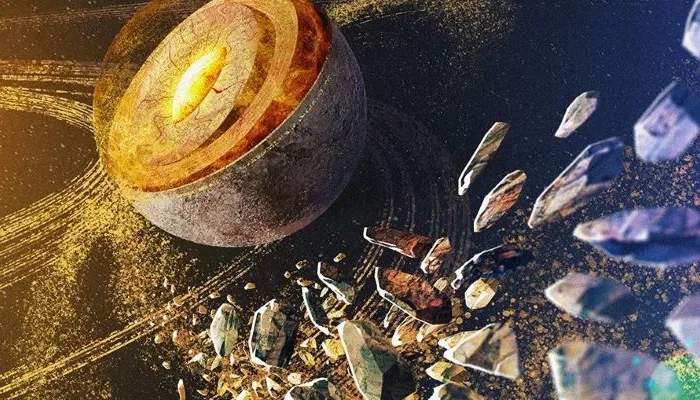
Billions of years ago, in the giant disk of dust, gas, and rocky material that orbited our young sun, larger and larger bodies coalesced to eventually give rise to the planets, moons, and asteroids we see today. Scientists are still trying to understand the processes by which planets, including our home planet, were formed. One way researchers can study how Earth formed is to examine the magmas that flow up from deep within the planet’s interior. The chemical signatures from these samples contain a record of the timing and the nature of the materials that came together to form Earth—analogous to how fossils give us clues about Earth’s biological past.
Now, a study from Caltech shows that the early Earth accreted from hot and dry materials, indicating that our planet’s water—the crucial component for the evolution of life—must have arrived late in the history of Earth’s formation.
The study, involving an international team of researchers, was conducted in the laboratories of Francois Tissot, assistant professor of geochemistry and Heritage Medical Research Institute Investigator; and Yigang Zhang of the University of Chinese Academy of Sciences. A paper describing the research appears in the journal Science Advances. Caltech graduate student Weiyi Liu is the paper’s first author.
Though humans do not have a way to journey into the interior of our planet, the rocks deep within the earth can naturally make their way to the surface in the form of lavas. The parental magmas of these lavas can originate from different depths within Earth, such as the upper mantle, which begins around 15 kilometers under the surface and extends for about 680 kilometers; or the lower mantle, which spans from a depth of 680 kilometers all the way to the core–mantle boundary at about 2,900 kilometers below our feet. Like sampling different layers of a cake—the frosting, the filling, the sponge—scientists can study magmas originating from different depths to understand the different “flavors” of Earth’s layers: the chemicals found within and their ratios with respect to one another.
Because the formation of Earth was not instantaneous and instead involved materials accreting over time, samples from the lower mantle and upper mantle give different clues to what was happening over time during Earth’s accretion. In the new study, the team found that the early Earth was primarily composed of dry, rocky materials: chemical signatures from deep within the planet showed a lack of so-called volatiles, which are easily evaporated materials like water and iodine. In contrast, samples of the upper mantle revealed a higher proportion of volatiles, three times of those found in the lower mantle. Based on these chemical ratios, Liu created a model that showed Earth formed from hot, dry, rocky materials, and that a major addition of life-essential volatiles, including water, only occurred during the last 15 percent (or less) of Earth’s formation.
The study is a crucial contribution to theories of planet formation, a field which has undergone several paradigm shifts in recent decades and is still characterized by vigorous scientific debate. In this context, the new study makes important predictions for the nature of the building blocks of other terrestrial planets—Mercury and Venus—which would be expected to have formed from similarly dry materials.
“Space exploration to the outer planets is really important because a water world is probably the best place to look for extraterrestrial life,” Tissot says. “But the inner solar system shouldn’t be forgotten. There hasn’t been a mission that’s touched Venus’s surface for nearly 40 years, and there has never been a mission to the surface of Mercury. We need to be able to study those worlds to better understand how terrestrial planets such as Earth formed.”
The paper is titled “I/Pu reveals Earth mainly accreted from volatile-poor differentiated planetesimals.” In addition to Liu and Tissot, co-authors are Zhang of the University of Chinese Academy of Sciences; Guillaume Avice of the Université Paris Cité, Institut de physique du globe de Paris; Zhilin Ye of the Chinese Academy of Sciences; and Qing-Zhu Yin of the University of California, Davis. Funding was provided by the Chinese Academy of Sciences, the National Science Foundation, a Packard Fellowship for Science and Engineering, the Heritage Medical Research Institute, and Caltech.
Source – Caltech


Elon Musk: Business Leader Behind Tesla, SpaceX, and xAI
Quick Facts Field Details Full Name Elon Reeve Musk Born June 28, 1971 Birthplace Pretoria, South Africa Nationality South African,...


Best Places to Visit in Vietnam – Complete Travel Guide
Vietnam is one of the most rewarding destinations in Southeast Asia. It’s a country where emerald bays meet towering limestone...


Best iPhones to Buy in 2026: Top 7 Models Compared with Features, Prices, and Expert Advice
Choosing the best iPhone to buy in 2026 is not simply about picking the newest release. With several generations still...


Why Gold and Silver Are Rising: What’s Driving Precious Metals’ Strong Momentum
Gold and silver are gaining strength as investors seek safe-haven assets amid global economic and geopolitical uncertainty. Silver is outperforming...


Best Hospitals in India for Heart Surgery – Top Cardiac Care Centers in 2026
Heart disease is a significant health challenge in India and worldwide. With rising incidence of coronary artery disease, heart attacks,...


Best Airline Loyalty Programs in 2026: Which Frequent Flyer Programs Are Really Worth It?
Spend enough time in airports and you’ll notice something interesting. Some travelers move effortlessly — priority check-in, lounge access, early...


Best Medical Schools in the US in 2026: A Complete and Easy Guide for Future Doctors
Choosing from the best medical schools in the US is one of the most important decisions in a future doctor’s...


Cars Below 15 Lakhs in India: The Complete Buyer’s Guide for 2026
The Indian automobile market in 2026 has entered a value-driven era. Buyers no longer need to exceed their budget to...


Cuisine of the Middle East: Flavours That Carry History on Every Plate
There’s a reason people speak of the cuisine of the Middle East with a certain reverence. It isn’t simply about...


Credit Card With Benefits Best: How to Maximize Value
Credit cards have become part of everyday life — from paying utility bills to booking travel online. But today, a...