
Education
Star Eats Planet, Brightens Dramatically
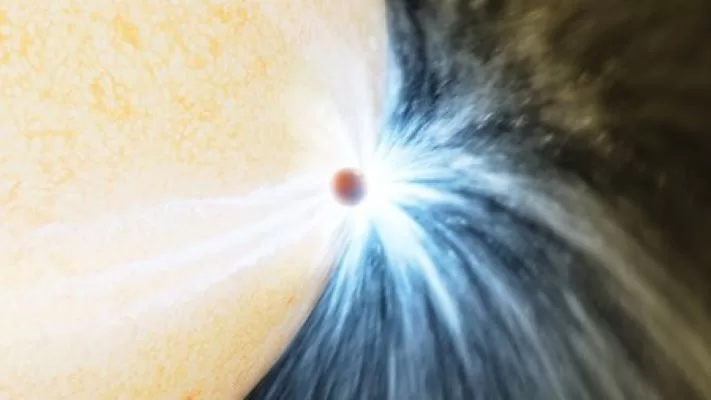
ZTF and NEOWISE spot evidence for the first known case of a star engulfing its planet
For the first time, astronomers have caught a star in the act of swallowing a planet whole. The sun-like star, called ZTF SLRN-2020, lies about 12,000 light-years away in our galaxy and is thought to have engulfed a hot gas giant about the size of Jupiter. Scientists already knew that older stars will, as they puff up with age, ultimately ingest their inner orbiting planets. Our own sun is predicted to do so in 5 billion years, consuming Mercury, Venus, and likely Earth. But nobody had seen direct evidence for such a remarkable scenario until now.
“The confirmation that sun-like stars engulf inner planets provides us with a missing link in our understanding of the fates of solar systems, including our own,” says Kishalay De (MS ’18, PhD ’21), a postdoctoral scholar at MIT and lead author of a new study about the findings in the journal Nature.
The plump star was first spotted by Zwicky Transient Facility, or ZTF, a National Science Foundation–funded instrument that scans the skies every night from Caltech’s Samuel Oschin Telescope at Palomar Observatory near San Diego. ZTF observations showed that the star had dramatically brightened and begun to fade in a period of about a week. At first, De thought this variable star might have resulted from a nova explosion, which occurs when a dead star called a white dwarf steals matter from its companion star. But follow-up observations with the W. M. Keck Observatory atop Maunakea in Hawaiʻi revealed something else was going on.
“I had been looking for erupting stars called novae,” De says. “But the Keck data indicated that the star was not lighting up hot gas as is expected for novae. I couldn’t make any sense of it.”
De, who was then a graduate student at Caltech, put the object aside to finish his PhD thesis and came back to it about a year later after he had moved to MIT. He and his colleagues then obtained infrared data from a camera at Palomar’s Hale Telescope called WIRC (Wide-field Infrared Camera), “and that’s when things got really interesting,” he says.
Those observations showed that the star was brightening over time in not only optical light as ZTF had observed but also in infrared light, which indicates the presence of dust. The researchers then turned to NASA’s NEOWISE space telescope in search of more clues. NEOWISE, formerly known as WISE (Wide-field Infrared Survey Explorer), has been scanning the skies regularly since shortly after its launch in 2009. NEOWISE detected the star brightening in infrared light about nine months before ZTF caught the extreme rise in optical light. Even now, after the optical light has faded, NEOWISE continues to pick up infrared light from the star.
“The infrared observations were one of the main clues that we were looking at a star engulfing a planet,” says Viraj Karambelkar (MS ’21), a grad student at Caltech and co-author of the study.
Once the science team put all the evidence together, they realized that the dust they were seeing with NEOWISE was being generated as a planet spiraled into the star’s puffy atmosphere. Like other older stars, the star had begun to expand in size as it aged, bringing it closer to the orbiting planet. As the planet skimmed the surface of the star, it pulled hot gas off the star that then drifted outward and cooled, forming dust. In addition, material from the disintegrating planet blew outward, also forming dust.
What happened next, according to the astronomers, triggered the flare of optical light seen by ZTF.
“The planet plunged into the core of the star and got swallowed whole. As it was doing this, energy was transferred to the star,” De explains. “The star blew off its outer layers to get rid of the energy. It expanded and brightened, and the brightening is what ZTF registered.”
Some of this expanding stellar material then escaped from the star and traveled outward. Like the boiled-off layers of the star and planet that previously drifted outward, this material also cooled to form dust.
NEOWISE is detecting the infrared glow of all the newly minted dust.
“NEOWISE data are a treasure trove,” says co-author Mansi Kasliwal (MS ’07, PhD ’11), professor of astronomy at Caltech and a co-investigator on the ZTF project. “ZTF caught the event, which is what it excels at, while NEOWISE and other telescopes all helped us figure out what is going on.”
The planetary engulfment is similar to what happens when two stars merge, events called red novae. Stars in our universe often form in pairs. Over time, as one star ages and expands faster than its companion, it can essentially ingest its partner. Twenty of these star mergers have been detected to date by ZTF and other instruments, mostly in galaxies beyond the Milky Way.
“Star mergers are thousands of times brighter than this event,” says Karambelkar, who has observed eight of these eruptions using ZTF as part of his PhD thesis. “This was another clue that we were looking at a planet being eaten by its star. The level of brightening was much fainter due to the small size of the planet.”
“This is just spectacular,” Kasliwal adds. “We are still amazed that we caught a star in the act of ingesting its planet, something our own sun will do to its inner planets. That’s a long time from now, in five billion years, so we don’t have to worry just yet.”
The Nature study titled “An infrared transient from a star engulfing a planet,” was funded by NASA, the National Science Foundation (NSF), and the Heising-Simons Foundation.
Caltech’s ZTF is funded by the NSF and an international collaboration of partners. Additional support comes from the Heising-Simons Foundation and from Caltech. ZTF data are processed and archived by Caltech’s IPAC. NASA supports ZTF’s search for near-Earth objects through the Near-Earth Object Observations program.
Launched in 2009, the WISE spacecraft was placed into hibernation in 2011 after completing its primary mission. In September 2013, NASA reactivated the spacecraft with the primary goal of scanning for near-Earth objects, or NEOs, and the mission and spacecraft were renamed NEOWISE. The mission was selected competitively under NASA’s Explorers Program managed by the agency’s Goddard Space Flight Center in Greenbelt, Maryland. NEOWISE is a project of JPL, which is managed by Caltech for NASA, and the University of Arizona and is supported by NASA’s Planetary Defense Coordination Office. Science data processing takes place at IPAC at Caltech.
Source – Caltech


Elon Musk: Business Leader Behind Tesla, SpaceX, and xAI
Quick Facts Field Details Full Name Elon Reeve Musk Born June 28, 1971 Birthplace Pretoria, South Africa Nationality South African,...


Best Places to Visit in Vietnam – Complete Travel Guide
Vietnam is one of the most rewarding destinations in Southeast Asia. It’s a country where emerald bays meet towering limestone...


Best iPhones to Buy in 2026: Top 7 Models Compared with Features, Prices, and Expert Advice
Choosing the best iPhone to buy in 2026 is not simply about picking the newest release. With several generations still...


Why Gold and Silver Are Rising: What’s Driving Precious Metals’ Strong Momentum
Gold and silver are gaining strength as investors seek safe-haven assets amid global economic and geopolitical uncertainty. Silver is outperforming...


Best Hospitals in India for Heart Surgery – Top Cardiac Care Centers in 2026
Heart disease is a significant health challenge in India and worldwide. With rising incidence of coronary artery disease, heart attacks,...


Best Airline Loyalty Programs in 2026: Which Frequent Flyer Programs Are Really Worth It?
Spend enough time in airports and you’ll notice something interesting. Some travelers move effortlessly — priority check-in, lounge access, early...


Best Medical Schools in the US in 2026: A Complete and Easy Guide for Future Doctors
Choosing from the best medical schools in the US is one of the most important decisions in a future doctor’s...


Cars Below 15 Lakhs in India: The Complete Buyer’s Guide for 2026
The Indian automobile market in 2026 has entered a value-driven era. Buyers no longer need to exceed their budget to...


Cuisine of the Middle East: Flavours That Carry History on Every Plate
There’s a reason people speak of the cuisine of the Middle East with a certain reverence. It isn’t simply about...


Credit Card With Benefits Best: How to Maximize Value
Credit cards have become part of everyday life — from paying utility bills to booking travel online. But today, a...