
Education
‘Veggie’ Dinosaurs Differed In How They Ate Their Food
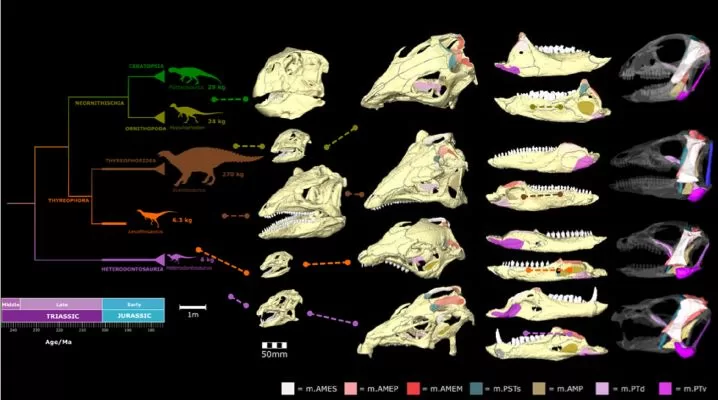
Scientists discover differences in the way early herbivore dinosaurs ate their food
Although most early dinosaurs were vegetarian, there were a surprising number of differences in the way that these animals tackled eating a plant-based diet, a new study reveals.
Scientists used CT scans of dinosaur skulls to track the evolution of early dinosaur herbivores – reconstructing jaw muscles and measuring the animals’ bite force to understand how dinosaur feeding evolved.
Five skulls from the plant-eating group Ornithischia provided the key to unlocking their feeding habits: Heterodontosaurus, Lesothosaurus, Scelidosaurus, Hypsilophodon and Psittacosaurus – earliest representatives of what would become the major herbivore dinosaur groups.
We discovered that each dinosaur tackled the problems posed by a plant-based diet by adopting very different eating techniques. Some compensated for low eating performance through their sheer size, whilst others developed bigger jaw muscles, increased jaw system efficiency, or combined these approaches. Although these animals looked very similar, their individual solutions to the same problems illustrates the unpredictable nature of evolution.
Dr Stephan Lautenschlager – University of Birmingham
Later ornithischian dinosaurs, like Triceratops and Stegosaurus, show a wide range of adaptations to eating plants yet their early relatives have not been examined properly, until now.
Publishing their findings in Current Biology, scientists from the Natural History Museum and the Universities of Birmingham and Bristol discovered that the early ‘veggie’ dinosaurs had evolved very different ways to tackle a diet of plants.
Heterodontosaurus appears to have large jaw muscles relative to its skull size – producing a high bite force, ideal for consuming tough vegetation. Scelidosaurus had a similar bite force, but relatively smaller jaw muscles compared to its skull. However, these animals had a greater overall body size and could achieve a strong bite. In contrast, the Hypsilophodon skull doesn’t have big muscles. Instead, these dinosauras reoriented their muscles, to bite more efficiently but with less muscle force.
Dr Stephan Lautenschlager, from the University of Birmingham, commented: “We discovered that each dinosaur tackled the problems posed by a plant-based diet by adopting very different eating techniques. Some compensated for low eating performance through their sheer size, whilst others developed bigger jaw muscles, increased jaw system efficiency, or combined these approaches. Although these animals looked very similar, their individual solutions to the same problems illustrates the unpredictable nature of evolution.”
Contrary to popular belief most dinosaurs were plant eaters, although they are all descended from a carnivorous ancestor. Much is already known about how different dinosaurs consumed their food, but relatively little is understood about how they evolved their preferred eating styles.
After CT scanning the skulls, the team reconstructed the jaw muscles using data from birds and crocodiles to help indicate where the muscles would have been. They then carried out a ‘finite element analysis’, which involves dividing the skull into thousands of individual parts (called elements). The bite force these muscles can generate is calculated based on their size and arrangement.
Each skull was then simulated to bite an imaginary object to see how the different elements respond to the applied force. These models generate heat maps showing the areas of the skull that are strongly stressed and those that are not very stressed. The results revealed that although all of these dinosaurs were eating plants, they each had different ways of doing it.
Senior author and palaeontologist at the Museum of Natural History Professor Paul Barrett commented: “If you want to understand how dinosaurs diversified into so many different types so effectively, it’s critical to learn how they evolved to feed on a such a wide variety of vegetation in so many ways. This diversity in feeding mechanisms set them up to dominate life on land for millions of years to come.”
Dr David Button, lead author of the study, who conducted the work at the Museum but is now a researcher at the University of Bristol, commented: “When we compared the functional performance of the skull and teeth of these plant-eating dinosaurs, we found significant differences in the relative sizes of the jaw muscles, bite forces and jaw strength between them. This showed that these dinosaurs, although looking somewhat similar, had evolved very different ways to tackle a diet of plants.
“This research helps us understand how animals evolve to occupy new ecological niches. It shows that even similar animals adopting similar diets won’t always evolve the same characteristics. This highlights how innovative and unpredictable evolution can be.”


Best Phones Under 20000 in India 2026: Top 7 Picks
Finding the best phones under 20000 in India has never been this rewarding. In 2026, this price band buys a...


Brand Loyalty: How Successful Brands Keep Customers Coming Back
Featured image — Source: Thirdman / Pexels It costs far more to win a new customer than to keep an...


Brand Awareness: Effective Strategies to Grow Your Business
Featured image — Source: Anurag Jamwal / Pexels Before anyone can buy from you, love you, or recommend you, they...


Brand Equity Explained: Meaning, Importance, and Examples
Featured image — Source: Ann H / Pexels Two bottles of fizzy brown cola sit side by side. One is...


Best Phones Software Updates in 2026: How Many Years of Support Every Brand Gives
When you buy a phone in 2026, the spec that quietly matters most isn’t the camera or the chip —...


Brand Positioning: Definition, Strategies, and Real-World Examples
Featured image — Source: Leeloo The First / Pexels Two coffee shops sit on the same street, sell a similar...

Brand Identity vs Brand Image vs Brand Reputation: Key Differences
Featured image — Source: Eva Bronzini / Pexels Ask ten marketers to explain the difference between brand identity vs brand...


How to Build a Brand From Scratch: A Step-by-Step Guide
Featured image — A brand starts with strategy, not a logo. Source: Walls.io / Pexels Every business you admire started...


What Is Branding? A Complete Beginner’s Guide
Ask ten people what branding means and you’ll get ten different answers. Some say it’s your logo. Others point to...


Best Perfume Brands in India (2026): Top Luxury & Affordable Fragrances Ranked
Choosing from the best perfume brands in India has never been more exciting — or more confusing. Walk into any...