
Education
Earth Formed from Dry, Rocky Building Blocks
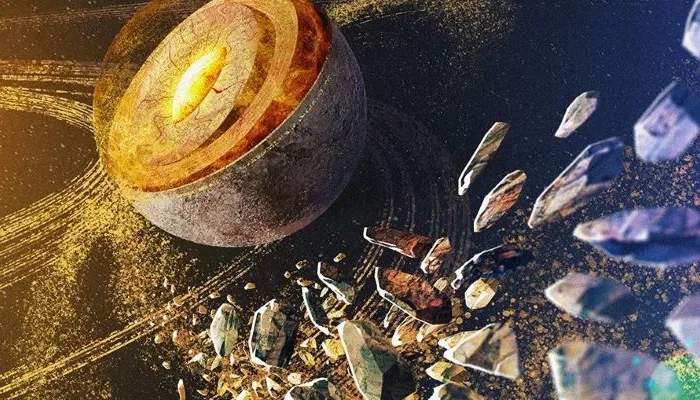
Billions of years ago, in the giant disk of dust, gas, and rocky material that orbited our young sun, larger and larger bodies coalesced to eventually give rise to the planets, moons, and asteroids we see today. Scientists are still trying to understand the processes by which planets, including our home planet, were formed. One way researchers can study how Earth formed is to examine the magmas that flow up from deep within the planet’s interior. The chemical signatures from these samples contain a record of the timing and the nature of the materials that came together to form Earth—analogous to how fossils give us clues about Earth’s biological past.
Now, a study from Caltech shows that the early Earth accreted from hot and dry materials, indicating that our planet’s water—the crucial component for the evolution of life—must have arrived late in the history of Earth’s formation.
The study, involving an international team of researchers, was conducted in the laboratories of Francois Tissot, assistant professor of geochemistry and Heritage Medical Research Institute Investigator; and Yigang Zhang of the University of Chinese Academy of Sciences. A paper describing the research appears in the journal Science Advances. Caltech graduate student Weiyi Liu is the paper’s first author.
Though humans do not have a way to journey into the interior of our planet, the rocks deep within the earth can naturally make their way to the surface in the form of lavas. The parental magmas of these lavas can originate from different depths within Earth, such as the upper mantle, which begins around 15 kilometers under the surface and extends for about 680 kilometers; or the lower mantle, which spans from a depth of 680 kilometers all the way to the core–mantle boundary at about 2,900 kilometers below our feet. Like sampling different layers of a cake—the frosting, the filling, the sponge—scientists can study magmas originating from different depths to understand the different “flavors” of Earth’s layers: the chemicals found within and their ratios with respect to one another.
Because the formation of Earth was not instantaneous and instead involved materials accreting over time, samples from the lower mantle and upper mantle give different clues to what was happening over time during Earth’s accretion. In the new study, the team found that the early Earth was primarily composed of dry, rocky materials: chemical signatures from deep within the planet showed a lack of so-called volatiles, which are easily evaporated materials like water and iodine. In contrast, samples of the upper mantle revealed a higher proportion of volatiles, three times of those found in the lower mantle. Based on these chemical ratios, Liu created a model that showed Earth formed from hot, dry, rocky materials, and that a major addition of life-essential volatiles, including water, only occurred during the last 15 percent (or less) of Earth’s formation.
The study is a crucial contribution to theories of planet formation, a field which has undergone several paradigm shifts in recent decades and is still characterized by vigorous scientific debate. In this context, the new study makes important predictions for the nature of the building blocks of other terrestrial planets—Mercury and Venus—which would be expected to have formed from similarly dry materials.
“Space exploration to the outer planets is really important because a water world is probably the best place to look for extraterrestrial life,” Tissot says. “But the inner solar system shouldn’t be forgotten. There hasn’t been a mission that’s touched Venus’s surface for nearly 40 years, and there has never been a mission to the surface of Mercury. We need to be able to study those worlds to better understand how terrestrial planets such as Earth formed.”
The paper is titled “I/Pu reveals Earth mainly accreted from volatile-poor differentiated planetesimals.” In addition to Liu and Tissot, co-authors are Zhang of the University of Chinese Academy of Sciences; Guillaume Avice of the Université Paris Cité, Institut de physique du globe de Paris; Zhilin Ye of the Chinese Academy of Sciences; and Qing-Zhu Yin of the University of California, Davis. Funding was provided by the Chinese Academy of Sciences, the National Science Foundation, a Packard Fellowship for Science and Engineering, the Heritage Medical Research Institute, and Caltech.
Source – Caltech


Best Phones Under 20000 in India 2026: Top 7 Picks
Finding the best phones under 20000 in India has never been this rewarding. In 2026, this price band buys a...


Brand Loyalty: How Successful Brands Keep Customers Coming Back
Featured image — Source: Thirdman / Pexels It costs far more to win a new customer than to keep an...


Brand Awareness: Effective Strategies to Grow Your Business
Featured image — Source: Anurag Jamwal / Pexels Before anyone can buy from you, love you, or recommend you, they...


Brand Equity Explained: Meaning, Importance, and Examples
Featured image — Source: Ann H / Pexels Two bottles of fizzy brown cola sit side by side. One is...


Best Phones Software Updates in 2026: How Many Years of Support Every Brand Gives
When you buy a phone in 2026, the spec that quietly matters most isn’t the camera or the chip —...


Brand Positioning: Definition, Strategies, and Real-World Examples
Featured image — Source: Leeloo The First / Pexels Two coffee shops sit on the same street, sell a similar...


Brand Identity vs Brand Image vs Brand Reputation: Key Differences
Featured image — Source: Eva Bronzini / Pexels Ask ten marketers to explain the difference between brand identity vs brand...


How to Build a Brand From Scratch: A Step-by-Step Guide
Featured image — A brand starts with strategy, not a logo. Source: Walls.io / Pexels Every business you admire started...


What Is Branding? A Complete Beginner’s Guide
Ask ten people what branding means and you’ll get ten different answers. Some say it’s your logo. Others point to...


Best Perfume Brands in India (2026): Top Luxury & Affordable Fragrances Ranked
Choosing from the best perfume brands in India has never been more exciting — or more confusing. Walk into any...