
Education
New insights into the ocean’s oldest carbon
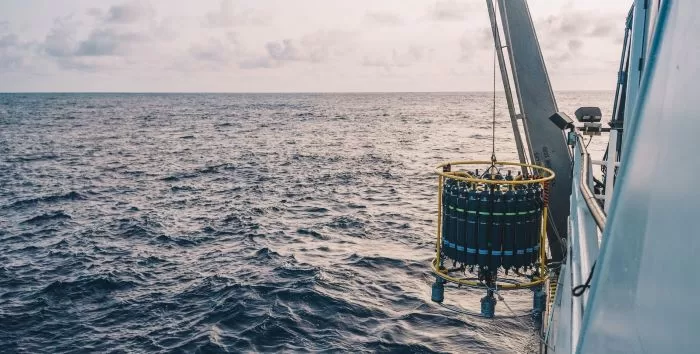
Using a newly developed technique, researchers have ruled out a potential source of ancient dissolved organic matter (DOM) in the world’s oceans.
DOM is organic material—mostly carbon, but also some nitrogen, sulfur, oxygen, and other elements—that is smaller than approximately 0.7 micrometers in size (tinier than a bacterium) and is dissolved in seawater. Because DOM is a major reservoir of carbon, this finding has implications for the sequestration of carbon in the deep ocean (generally defined as the area where light cannot penetrate, a depth of around 200 meters). DOM can exist in the deep ocean for hundreds to thousands of years, though no one is sure why it persists for so long.
The new research suggests that the accumulation of DOM in the deep ocean occurs with negligible input from organic sulfur compounds found in ocean sediments, and thus rejects one leading hypotheses for why it persists for so long.
“Our paper helped address a lingering question in carbon sequestration, rejecting a theory of where some old carbon was coming from,” says Alexandra Phillips (PhD ’21), lead author of a paper on the research that was published in Proceedings of the National Academy of Sciences (PNAS) on October 7. Phillips is a postdoctoral scholar at UC Santa Barbara, but conducted the research while a graduate student at Caltech with Alex Sessions, professor of geobiology
The ocean has about as much carbon in the form of DOM as there is carbon dioxide in the atmosphere. DOM is thought to be important for climate regulation because it essentially traps carbon for extended periods.
Phillips tested the hypothesis that extremely long-lived DOM exists due to reactions with hydrogen sulfide in porewaters (the water that flows through sediments on the ocean floor), creating molecules that then leech from sediments into the ocean. Such reactions are known to make molecules more resistant to microbial degradation, and scientists have previously linked the creation of “sulfurized” organic matter in sediments to cooling events in Earth’s history.
Phillips, Sessions, and their colleagues at Caltech, Scripps Institution of Oceanography, and the University of Oldenburg in Germany, used sulfur isotopes to test if these sulfurization reactions were also responsible for a significant portion of the deep ocean’s old carbon.
Phillips spent her time in graduate school at Caltech improving techniques for sulfur isotope measurement. The abundance of stable isotopes in a given sample often yields clues about its source. For example, sulfur most commonly occurs in two forms: sulfur-32 and sulfur-34 isotopes (with the heavier sulfur-34 isotope containing two more neutrons than sulfur-32). Analyzing the relative abundance of each isotope in a sample can tell you a bit about the sample’s origins. For example, microbes in areas without oxygen use sulfate (a molecule of sulfur and oxygen) for energy and create sulfide (a negatively charged sulfur ion) as a byproduct. This reaction is faster with the lighter sulfur-32 isotope, which in turn causes the resulting sulfide to have more sulfur-32.
However, for sulfur, the large sample sizes needed to accurately measure the isotope ratio made it an impractical way to study DOM. That is, until Phillips and her colleagues developed a way to analyze sulfur isotopes at very low levels, which in turn decreases the samples sizes needed from about 10 milligrams of DOM (yielding about 100 micrograms of sulfur) to about 0.1 milligrams of DOM (yielding about 1 microgram of sulfur).
In practical terms, it is the difference between filtering only 10 liters of seawater per sample instead of 1,000 liters.
“This is a classic example of how fundamental research into improving measurement techniques can pay dividends in terms of new science,” Sessions says. “With Alex’s thesis work helping to lower detection limits for organic sulfur isotopes by two orders of magnitude, the analysis of marine DOM suddenly became quite practical.”
Their measurement relied on burning small amounts of isolated DOM samples and precisely analyzing the resulting gas mixture using mass spectrometry. This allowed the team to measure the isotope ratios of each gas that emerges in fine detail. The Sessions Lab at Caltech has been refining similar techniques for years—but this was the first field test of these new sulfur isotope methods.
“It was like we were a hammer searching for nails,” Phillips says. “We spent time developing this awesome method and were eager to apply it to answer a big question. This method really opened the floodgates for possible measurements of organic sulfur.”
The team found sulfur isotope signals that did not match a sedimentary source. The samples, collected from deep in the Pacific and Atlantic oceans, had much more sulfur-34 than would be expected if the material originated from sulfurized organic matter. The researchers also noted that as the relative abundance of sulfur-34 decreased in their samples, the samples also showed an overall loss of sulfur relative to carbon. This further disproved the hypothesis that sulfurized organic matter was the missing source of the ocean’s oldest dissolved carbon.
Instead, the sulfur isotope ratios were nearly identical to those found in phytoplankton, the microscopic photosynthesizing organisms that comprise the base of the marine food web. The findings offer direct evidence that phytoplankton is the origin of the sulfur, and indirect evidence for the origin of DOM in general. However, it should be noted that sulfur-containing compounds comprise less than 10 percent of typical DOM.
“Most people who study sulfur use it just as a window into carbon cycling, but I think this result shows that biology is also the starting point for sulfur,” Phillips says. “Marine organic sulfur is a lot more dynamic than we were expecting.”
The PNAS paper is titled “Novel sulfur isotope analyses constrain sulfurized porewater fluxes as a minor component of marine dissolved organic matter.” Caltech coauthors include Fenfang Wu, laboratory manager; Frank J. Pavia, Stanback Postdoctoral Scholar Research Associate in Environmental Science and Engineering; and former graduate student Preston C. Kemeny (MS ’18, PhD ’22), who is now a postdoctoral fellow at the University of Chicago. Other coauthors include Margot E. White and Lihini I. Aluwihare of Scripps Institution of Oceanography in San Diego; Audrey C. Ma of USC; and Michael Seidel and Thorsten Dittmar of the University of Oldenburg in Germany. Funding for this work came from the National Science Foundation, the German Research Foundation (DFG), and the Fannie and John Hertz Foundation.
Source – Caltech


Best Phones Under 20000 in India 2026: Top 7 Picks
Finding the best phones under 20000 in India has never been this rewarding. In 2026, this price band buys a...


Brand Loyalty: How Successful Brands Keep Customers Coming Back
Featured image — Source: Thirdman / Pexels It costs far more to win a new customer than to keep an...


Brand Awareness: Effective Strategies to Grow Your Business
Featured image — Source: Anurag Jamwal / Pexels Before anyone can buy from you, love you, or recommend you, they...

Brand Equity Explained: Meaning, Importance, and Examples
Featured image — Source: Ann H / Pexels Two bottles of fizzy brown cola sit side by side. One is...


Best Phones Software Updates in 2026: How Many Years of Support Every Brand Gives
When you buy a phone in 2026, the spec that quietly matters most isn’t the camera or the chip —...


Brand Positioning: Definition, Strategies, and Real-World Examples
Featured image — Source: Leeloo The First / Pexels Two coffee shops sit on the same street, sell a similar...


Brand Identity vs Brand Image vs Brand Reputation: Key Differences
Featured image — Source: Eva Bronzini / Pexels Ask ten marketers to explain the difference between brand identity vs brand...


How to Build a Brand From Scratch: A Step-by-Step Guide
Featured image — A brand starts with strategy, not a logo. Source: Walls.io / Pexels Every business you admire started...


What Is Branding? A Complete Beginner’s Guide
Ask ten people what branding means and you’ll get ten different answers. Some say it’s your logo. Others point to...


Best Perfume Brands in India (2026): Top Luxury & Affordable Fragrances Ranked
Choosing from the best perfume brands in India has never been more exciting — or more confusing. Walk into any...