
Education
First Excvated Evidence of Roman Metal Mining in Cornwall Found
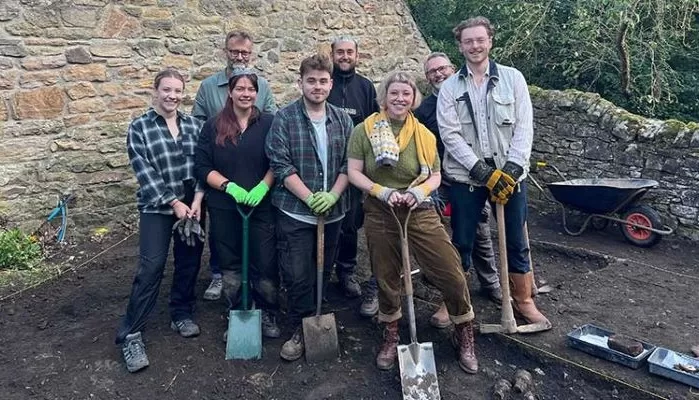
The new series of the Great British Dig has unearthed the first excavated evidence that the Roman army were mining metals in Cornwall within just a few years of invading Britain.
Roman military mining
In the latest series, the team, which includes Newcastle University archaeologist Dr Chloe Duckworth, go to Calstock Roman fort, near the river Tamar in Cornwall, to find out why it was built at that particular location, if there was a vicus – a civilian area immediately outside the fort – and how it related to the rest of Roman Cornwall.
Dating from around AD 50, Calstock Roman fort was discovered in 2007 by a team led by Dr Chris Smart from the University of Exeter while carrying out geophysical surveys of the area to look for signs of a Medieval silver mining industry.
Dr Smart has led a programme of funded research digs at Calstock since 2008, which has mapped out the scale of the fort and many of the buildings within it.
Until recently, it was thought that the Roman frontier in South West Britain stopped at Exeter but the discovery of Calstock Roman fort led to new questions about why the Romans came to Cornwall and what they were doing there.
Cornwall has been internationally important for metal production, especially tin, since the Bronze Age but, to date, no evidence for mining in Cornwall by the Romans has been found, despite it being known for some time that they were interested in Britain for its mineral resources.
In the first episode of the new series, which will be broadcast on Thursday 15 June, Dr Duckworth and the Great British Dig team are joined by Dr Smart. Together with volunteers from Calstock village, they try to learn more about some of the features that showed up on the 2007 geophysical survey of the site including a road that appears to lead into the fort and could have connected it to the rest of Cornwall, and some mysterious black patches.
During the programme, Dr Duckworth analyses pieces of rocky material found while excavating these strange patches using a specialist portable x-ray fluorescence (pXRF) device. This shows that it was Roman mining waste and is the first excavated evidence that the Romans were mining for the mineral-rich deposits in Cornwall.
Dr Duckworth said: “The week in Calstock was a massive success and provided some genuinely exciting discoveries. Not only did we find the first excavated evidence of Roman mining in Cornwall, but the diversity of finds our volunteers were making suggests that although it was only occupied for a short time, Calstock was clearly an important site for the Romans.”
Dr Smart said: “With each successive excavation, we have been able to gradually reconstruct what was happening at Calstock, who was inhabiting it and what activities took place inside the defences. So, I am delighted that the team at the Great British Dig has made such a welcome contribution to answering some of the outstanding questions we had, including the involvement of the Roman military in mining in this landscape.”
Unearthing the lost history of Cherryburn
The new series also visits Northumberland, to the home of naturalist Thomas Bewick, at Cherryburn, in Mickley.
The team enlisted the help of a group of Newcastle University archaeology students to investigate the garden at Cherryburn to see if they could find part of the original cottage which was lost when it was demolished in the 19th century.
Now a National Trust property, Cherryburn was the birthplace of Thomas Bewick, who in the 18th century, revolutionised the technique of woodcut engraving. By using blocks of wood which had been cut across the grain rather than along it, Bewick was able to create intricate, finely-detailed wood engravings depicting a variety of rural scenes and the natural world.
Bewick’s love of nature began when he was a child, spending most of his time playing outside and watching the wildlife around Mickley and Ovingham and also on his parents’ farm at Cherryburn.
The excavation explored the area next to the house where Bewick and his family lived to look for the rest of the original building. Within a very short time of the excavation starting, the team had found the remains of an interior wall – part of which still had the original 18th century blue wall plaster attached. This allowed the show’s production team to create a brand new visualisation of what the full cottage would have looked like at the time when Bewick and his family lived there.
One of the six Newcastle University students who took part in the excavation is 21-year-old Rhys McConville, from Sunderland. The Stage 3 student, who will graduate next month, already had some experience of excavations from his course but working on a dig for television was something completely different. “Because we know we’re only on site for a short period of time, it’s a lot faster paced,” he said. “This has been a great opportunity to work with professional archaeologists in the field, including some Newcastle University archaeology alumni. It’s really given me an insight into commercial archaeology and what to expect after I graduate.”
Chloe Duckworth added: “It was really fun to be back filming with the crew of the Great British Dig, and even better to have some of our students involved. They are not only helping us to get a better understanding of the life of one of our finest artists and naturalists, but they are also developing important skills that are in-demand and will help them in their future careers, as well as ensuring we can continue to protect the history that is all around us.”
The episode at Cherryburn is the first of two episodes in the new series to take place at a National Trust property. The Great British Dig team also visit Studley Royal in North Yorkshire.
Source – Newcastle


Best Phones Under 20000 in India 2026: Top 7 Picks
Finding the best phones under 20000 in India has never been this rewarding. In 2026, this price band buys a...


Brand Loyalty: How Successful Brands Keep Customers Coming Back
Featured image — Source: Thirdman / Pexels It costs far more to win a new customer than to keep an...


Brand Awareness: Effective Strategies to Grow Your Business
Featured image — Source: Anurag Jamwal / Pexels Before anyone can buy from you, love you, or recommend you, they...


Brand Equity Explained: Meaning, Importance, and Examples
Featured image — Source: Ann H / Pexels Two bottles of fizzy brown cola sit side by side. One is...


Best Phones Software Updates in 2026: How Many Years of Support Every Brand Gives
When you buy a phone in 2026, the spec that quietly matters most isn’t the camera or the chip —...


Brand Positioning: Definition, Strategies, and Real-World Examples
Featured image — Source: Leeloo The First / Pexels Two coffee shops sit on the same street, sell a similar...


Brand Identity vs Brand Image vs Brand Reputation: Key Differences
Featured image — Source: Eva Bronzini / Pexels Ask ten marketers to explain the difference between brand identity vs brand...


How to Build a Brand From Scratch: A Step-by-Step Guide
Featured image — A brand starts with strategy, not a logo. Source: Walls.io / Pexels Every business you admire started...


What Is Branding? A Complete Beginner’s Guide
Ask ten people what branding means and you’ll get ten different answers. Some say it’s your logo. Others point to...


Best Perfume Brands in India (2026): Top Luxury & Affordable Fragrances Ranked
Choosing from the best perfume brands in India has never been more exciting — or more confusing. Walk into any...