
Technology
Huawei’s David Wang: Stride to Ultra-Broadband 5.5G
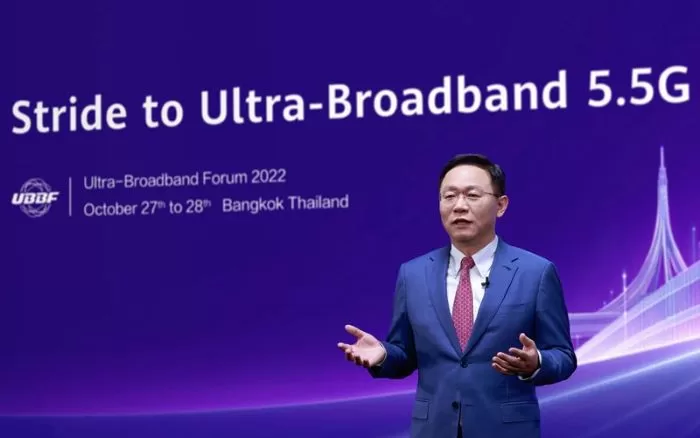
The Ultra-Broadband Forum 2022 raised its curtain today in Bangkok, with David Wang, Huawei’s Executive Director of the Board and Chairman of the ICT Infrastructure Managing Board, delivering a keynote speech titled Stride to Ultra-Broadband 5.5G. During this speech, Wang outlined the enormous changes that are set to take place in areas like smart homes, smart campuses, and industrial Internet by 2030. He also made it clear that ultra-broadband 5.5G will be a key milestone on the path to an intelligent world and recommended that the industry take four key steps to accelerate this process. He went on to call on all industry players to work together and move faster towards ultra-broadband 5.5G.
As we approach the intelligent world of 2030, home broadband speeds will reach 10 Gbit/s, marking a huge improvement over today’s 1 Gbit/s experience. Currently, homes have an average of 5 to 20 devices connected to their Wi-Fi networks. However, this is set to change as smart home devices see broad adoption, which will drive this number up to 150 to 200. It will therefore be essential that fiber can reach every room of every home.
By 2030, Wi-Fi networks will also be capable of delivering several 10 Gbit/s experiences for mid- and large-sized campuses, and will need to support intelligent operations and management. Micro and small enterprises will need Wi-Fi networks that can deliver large bandwidth, premium experiences, and one-stop intranet services. Industrial Internet will require a bandwidth higher than 10 Gbit/s and a latency lower than one millisecond. Enterprises will adopt a multi-cloud strategy that requires networks to dynamically adjust routing. Driven by green development and automation, we will see 10-fold increases in network capacity, energy efficiency, and O&M efficiency.
“Ultra-broadband 5.5G will be a key milestone on our path to this intelligent world. To hit this milestone, all industry players, including standards organizations, regulators, operators, and equipment vendors, will need to work together. I would like to call on you all to continue working together. Let’s leverage ultra-broadband 5.5G technologies, build 5.5G networks, and develop a 5.5G ecosystem. Together, we will move our industry forward and stride to ultra-broadband 5.5G,” stressed Wang.
The four steps Wang stated the industry must take to reach ultra-broadband 5.5G include:
First, defining next-gen standards and reaching consensus across the industry.
ETSI started leading the standardization of F5G Advanced with their Release 3 standard. And the ETSI White Paper: Fixed 5th Generation Advanced and Beyond, which is designed specifically for the optical industry, was released in September 2022. By 2025, smart home use cases and optical fiber sensing will be addressed by standards.
In the IP industry, Huawei also published a Net5.5G white paper during this forum. They believe that Net5.5G will achieve even larger bandwidth and realize flexible, end-to-end SRv6 optimization by 2023. By 2025, IP networks are expected to sense computing power and applications, allowing them to deliver more deterministic network experiences and service guarantee for more industrial scenarios.
Second, jointly promoting the rapid adoption of standards across entire product lifecycles, from technological breakthroughs to product development, deployment, and operations.
In optical access, GPON, 10G PON, and 50G PON Combo will be compatible with operators’ existing ODN networks and support their ongoing, smooth upgrade. The C-WAN architecture can be introduced on FTTR networks, supporting stable Gbit/s experiences throughout entire homes and cutting roaming handover times to less than 20 milliseconds.
In optical transmission, available spectrum for 400G WDM networks will increase from 8 THz to 12 THz. This will increase the number of available wavelengths by 50% and provide a single-fiber transmission capacity up to 100T. For metro WDM, new wavelength pooling WDM technology will be able to facilitate flexible sharing of metro wavelengths across multiple rings, greatly reducing TCO and supporting WDM deployment to access sites.
In terms of IP, Wi-Fi 7 will use technologies like CO-SR and CO-OFDMA to enhance collaboration between different access points and thus improve the network-wide experience. This will require the support of technologies like UL OFDMA and UL MU-MIMO, to improve Wi-Fi connection reliability. APN6 and SRv6 can also provide valuable support here by sensing computing power and application requirements and then dynamically configuring cloud resources so that companies can more quickly connect to clouds. Additionally, deterministic IP technologies can be used to reduce traffic microbursts and the end-to-end jitter on IP networks to less than 20 microseconds.
Third, rolling out ultra-broadband 5.5G more quickly using policies and target networks.
New standards and technologies can only create value when they are applied to live networks. Governments and regulators will therefore need to adopt more effective policies, including national broadband strategies, fiber deployment policies, and construction standards, to accelerate the rollout of gigabit FTTH networks and help bring fiber to every room in every home.
Operators also have an important role to play. They will need to define target network architectures for 2025 and 2030. They must also accelerate the rollout of FTTH and FTTR networks, deployment of metro WDM to access sites, upgrade from IP networks to SRv6 networks, and deployment of 400G and 800G for both transmission and IP networks.
Fourth, exploring new applications and building a prosperous ecosystem.
Industry players and ecosystem partners need to work together to explore what ultra-broadband 5.5G will look like. Ultra-Broadband 5.5G will be able to support new, high-potential applications, and once 10 Gbit/s everywhere is realized, applications like MetaVerse games and real-time interactions will see wider adoption. In addition, exploration will continue for new campus scenarios such as immersive offices and robot-assisted offices, and for micro and small enterprise services like one-stop Wi-Fi networks. Huawei believes the telecom industry will need to cooperate with industrial Internet companies as they continue working on deterministic experience and flexible routing in support of industrial Internet. This will help incubate applications for automated industrial control and enterprise connectivity to multiple clouds.
Already, this ongoing standardization is continuing to drive change in the ultra-broadband industry. Over the past 10 years, the world has seen 790 million new FTTH users, while over the past five years, 100 million users have started using gigabit services. Over the past year, an additional one million users have begun using FTTR services.
There are also already about 50.000 high-quality OTN private lines being used by enterprises, 600,000 cloud private enterprise lines, and over 27 million Wi-Fi 6 hotspots now available worldwide. This is all in addition to the 130 400G WDM networks, more than 15,000 all-optical, cross-connect ROADMs, and over 100 SRv6-supported IP networks that have already been rolled out globally.
Source – Huawei


Best Phones Under 20000 in India 2026: Top 7 Picks
Finding the best phones under 20000 in India has never been this rewarding. In 2026, this price band buys a...


Brand Loyalty: How Successful Brands Keep Customers Coming Back
Featured image — Source: Thirdman / Pexels It costs far more to win a new customer than to keep an...


Brand Awareness: Effective Strategies to Grow Your Business
Featured image — Source: Anurag Jamwal / Pexels Before anyone can buy from you, love you, or recommend you, they...


Brand Equity Explained: Meaning, Importance, and Examples
Featured image — Source: Ann H / Pexels Two bottles of fizzy brown cola sit side by side. One is...

Best Phones Software Updates in 2026: How Many Years of Support Every Brand Gives
When you buy a phone in 2026, the spec that quietly matters most isn’t the camera or the chip —...


Brand Positioning: Definition, Strategies, and Real-World Examples
Featured image — Source: Leeloo The First / Pexels Two coffee shops sit on the same street, sell a similar...

Brand Identity vs Brand Image vs Brand Reputation: Key Differences
Featured image — Source: Eva Bronzini / Pexels Ask ten marketers to explain the difference between brand identity vs brand...


How to Build a Brand From Scratch: A Step-by-Step Guide
Featured image — A brand starts with strategy, not a logo. Source: Walls.io / Pexels Every business you admire started...


What Is Branding? A Complete Beginner’s Guide
Ask ten people what branding means and you’ll get ten different answers. Some say it’s your logo. Others point to...


Best Perfume Brands in India (2026): Top Luxury & Affordable Fragrances Ranked
Choosing from the best perfume brands in India has never been more exciting — or more confusing. Walk into any...