
Education
Seeing in the Soil: An Underground Optics System Takes Root

Mere centimeters below our feet, just beneath grasses, trees, flowers, and moss, lies a complex ecosystem called the rhizosphere. Composed of the soil, fungi, nutrients, and more that surround plant roots, this layer plays an essential role in the well-being of the planet and the growth of the crops needed to feed its inhabitants.
“The health of the soil underpins the survival of the overall terrestrial biosphere,” says Changhuei Yang, Caltech’s Thomas G. Myers Professor of Electrical Engineering, Bioengineering, and Medical Engineering and a Heritage Medical Research Institute Investigator. “I think it is urgent that we put more attention and focus on understanding the biodynamics in the soil.”
Studies of the rhizosphere rely on soil and root samples taken from the ground, but this process upsets environmental conditions in the earth and gives an incomplete picture of the dynamics at play. Instead of digging up the dirt, Yang and members of his lab plan to build a camera they can bury in the soil to monitor the rhizosphere in its natural state. They plan to use this imaging system to capture interactions between organisms, root systems, and networks of fungi to learn more about how plants get the nutrients they need to thrive as well as how the rhizosphere will respond to global climate change.
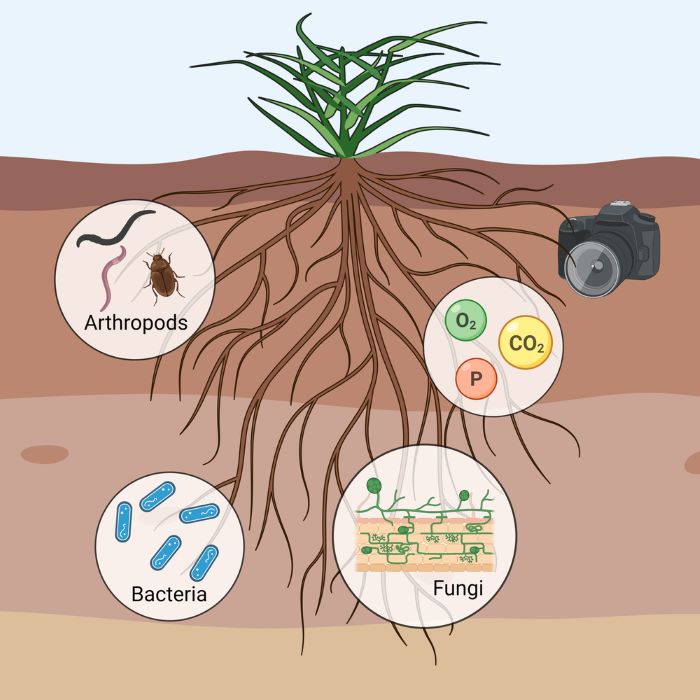
The project, funded in part by the Resnick Sustainability Institute and led by Oumeng Zhang, a postdoctoral scholar research associate in electrical engineering, was inspired by a conversation between Yang and Dianne Newman, the Gordon M. Binder/Amgen Professor of Biology and Geobiology, whose work focuses on how microorganisms co-evolve with their environment.
“As I started to understand more of the science, it became quite clear that the instruments used to study the rhizosphere could significantly benefit from some of the recent biomedical tool developments,” says Yang, whose biophotonics lab has mostly focused on building cameras for medical imaging.
For example, Newman and members of her lab are working on ways to monitor changes in phosphorus—a fundamental nutrient for all living things—in soil. Their goal is to develop specific bacteria that can improve the absorption of phosphorus in crops. Zhang has begun collaborating with her group and bringing his optical expertise to bear.
“To be able to sense all these fungi or bacteria under the soil and monitor them for a long period of time is something I’m really excited for because it’s never been done before.”
“I am building a fluorescence scanning system to identify the different kinds of proteins that bacteria express when they need more phosphorus,” he says. “I’m trying to use optical methods to detect these very subtle changes that are difficult to detect.”
Building an optical system that can operate underground comes with a particular set of challenges. The Yang lab’s cameras and microscopes typically operate on tables that are extremely stable, allowing for proper alignment. The earth, on the other hand, is full of wiggling creatures, and soil is easily moved around by rain, wind, and earthquakes, to name a few potential disruptors. Fortunately, Zhang says, the team can use computational methods to transform a fuzzy picture into a clearer one.
Another challenge is the wide scale of sizes of what the team aims to image, from microscopic bacteria to worms visible to the human eye.
“We just need to always be thinking about what kind of method is the most appropriate to see those things,” Zhang says. “To be able to sense all these fungi or bacteria under the soil and monitor them for a long period of time is something I’m really excited for because it’s never been done before.”
The ability to detect and image live organisms in the rhizosphere could have wide-ranging ramifications. If the team is successful in building the instruments Zhang has in mind, researchers might be able to send the cameras—or their next generation—to investigate environments on other planets. For now, though, the focus is to help researchers understand the response of the rhizosphere to global climate change.
“On a more local scale,” Yang notes, “since we can expect forest fires to occur more frequently and with greater intensity in California, I think it is important we study forest rhizospheric systems and better understand whether there is anything we can do to make them more resilient and able to bounce back more quickly after a fire.”
The robust camera system in development could be ready for testing by next summer, according to Zhang, whose PhD advisor at Washington University in St. Louis, Matthew Lew (BS ’08), was a former student of Yang’s and who recommended Zhang join Yang’s group because of the chance to innovate exactly these kinds of new technologies.
“The data will be useful for scientific research and would also be useful for just allowing the public to connect better with what is going on under our feet,” Yang says. “As humans, we are highly visual creatures.”


Best Phones Under 20000 in India 2026: Top 7 Picks
Finding the best phones under 20000 in India has never been this rewarding. In 2026, this price band buys a...


Brand Loyalty: How Successful Brands Keep Customers Coming Back
Featured image — Source: Thirdman / Pexels It costs far more to win a new customer than to keep an...

Brand Awareness: Effective Strategies to Grow Your Business
Featured image — Source: Anurag Jamwal / Pexels Before anyone can buy from you, love you, or recommend you, they...

Brand Equity Explained: Meaning, Importance, and Examples
Featured image — Source: Ann H / Pexels Two bottles of fizzy brown cola sit side by side. One is...


Best Phones Software Updates in 2026: How Many Years of Support Every Brand Gives
When you buy a phone in 2026, the spec that quietly matters most isn’t the camera or the chip —...


Brand Positioning: Definition, Strategies, and Real-World Examples
Featured image — Source: Leeloo The First / Pexels Two coffee shops sit on the same street, sell a similar...


Brand Identity vs Brand Image vs Brand Reputation: Key Differences
Featured image — Source: Eva Bronzini / Pexels Ask ten marketers to explain the difference between brand identity vs brand...

How to Build a Brand From Scratch: A Step-by-Step Guide
Featured image — A brand starts with strategy, not a logo. Source: Walls.io / Pexels Every business you admire started...


What Is Branding? A Complete Beginner’s Guide
Ask ten people what branding means and you’ll get ten different answers. Some say it’s your logo. Others point to...


Best Perfume Brands in India (2026): Top Luxury & Affordable Fragrances Ranked
Choosing from the best perfume brands in India has never been more exciting — or more confusing. Walk into any...